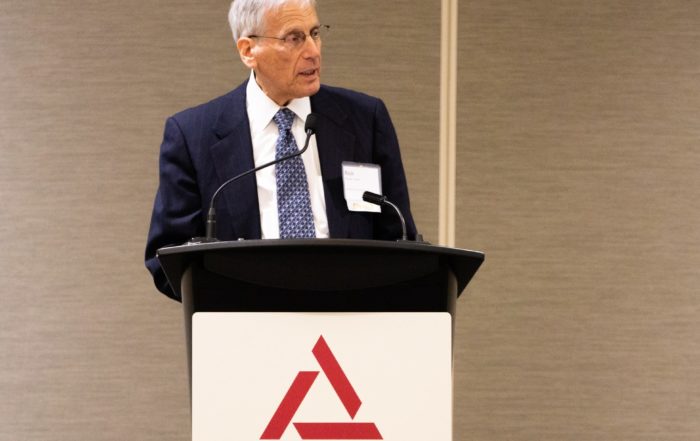
Food and Drug Law Institute Twelfth Annual Eric M. Blumberg Memorial Lecture
By Mark Raza
Former Chief Counsel, Office of the Commissioner, FDA
December 5, 2025
I would like to thank FDLI and the Committee for this opportunity. It is an honor to present the Blumberg Memorial Lecture. I was a colleague of Rick Blumberg’s in the Office of the Chief Counsel for almost 23 years. Rick and I were also close friends.
I am going to share some memories I have of Rick who, as many of you know, was a real character. And through the lens of Rick’s legacy, I will provide some brief thoughts on FDA enforcement writ large.
Before I get to that, I will start with two foundational contentions. First, FDA history matters. We seem to be at particular inflection point in which some would say that precedent and past agency practice and policy should be of little consequence in the face of current FDA or HHS priorities. As we know, different Administrations have different policy preferences. But proceeding without regard to what has gone before has its own risk, the danger being that whatever the current initiative or new program is, it simply won’t last or be sustained. And by FDA history, I particularly refer to the modern history of the agency from the 1960’s forward, through Peter Hutt’s tenure as Chief Counsel in the early 1970’s and the evolution of food and drug law, through the Reagan years to the ramp up of enforcement under Commissioner Kessler and the founding of the Office of Criminal Investigations (OCI). This history mirrors Rick Blumberg’s career in OCC starting in the early 1970’s and reflects much of his own handiwork, including his efforts on the Park case and other precedent-setting cases, and his leadership of the OCC litigation practice as the Deputy Chief Counsel for Litigation starting in the 1990’s through 2013.
My second contention is that FDA enforcement matters, and FDA has an important role to play in this arena. You could say the point is obvious, especially given the discussions here over the last day and a half. But I would argue that even in these unusual times (and even given current impulses concerning medical individuality, etc.), most would agree that there are certain cases in which FDA enforcement, whether civil or criminal, is not only entirely appropriate but also imperative. And by most, I include current leadership in FDA and HHS who, I think, would support enforcement in a particular case for purposes that could include punishment, deterrence, getting unsafe product off the market, putting a stop to significant manufacturing violations, protecting supply chains, and ensuring a level playing field for industry.
I think Rick Blumberg would agree with this. It’s worth mentioning that the prior Blumberg Memorial Lectures are on the FDLI website, and they are really something. Starting with the inaugural one by Annamarie Kempic and then Mark Brown, three former Chief Counsels, Ann Wion, John Fleder, and other notable members of the food and drug bar such as Howard Sklamberg, John Taylor, Jennifer Zachary, and Vernessa Pollard. These presentations provide fascinating insights about Rick and the practice and history of FDA enforcement.
I mentioned that Rick and I were friends. This was not always the case. When I started as a litigator in OCC in 1990, Rick was one of my supervisors and then my boss when he became the Deputy Chief Counsel for Litigation. What I remember most about this time is Rick yelling at me for messing up or just yelling at me. Rick would use a lot of profanity; Vernessa Pollard said it best in last year’s lecture—Rick “had an almost lyrical ability to combine expletives to form incongruous but entirely situationally appropriate phrases.” Rick would come bang on the door to my small interior office and say—regarding a proposed consent decree I was working on—“What the hell is this?!” Except that he would use another word in place of the term “hell.” And then he would say that the other side was going to take a particular draft provision in the decree and use it to do unspeakable things to us. Except that Rick would describe in colorful detail the unspeakable things that would be done.
Now to be fair, back then as a new lawyer and litigator, I didn’t really know what I was doing. But I wasn’t a faint heart; I had come up playing sports for old school coaches who weren’t necessarily kinder or gentler. Still, I found Rick to be a tough boss and frankly a bit much, and in the mid 90’s I switched to the OCC counseling practice under Deputy Chief Counsel for Program Review Ann Wion. So, it is somewhat improbable that Rick and I later became good friends. I’m not sure exactly how it happened. Likely it was because under Rick’s gruff exterior was a good guy who was devoted to FDA and OCC and genuinely cared about the people in the office. Rick supported me at certain crucial times, and for that I will always be grateful. We were on the OCC management team together and the last few years the two of us would often go out to lunch to a Greek diner near FDA. Rick would order a feta and spinach omelet and fries and when placing the order would kiddingly nudge the regular waiter to “this time not be so stingy with the F’n French fries.” Rick was a baseball fan. He was also a decent softball player as evident when we played DOJ on the Mall in the early 90’s. For the record, OCC won that game. Rick liked the Nationals and the Orioles. I believe he went to Nats games with Howard Sklamberg. Rick and I talked about getting to an O’s game in the 2013 season; we both liked Camden Yards. But then he ended up in the hospital in March 2013. We thought he had turned the corner, especially after he texted John Taylor and me from the hospital. So it was a real shock when Rick passed away a couple of days later. It’s going on 13 years, but sometimes I still can’t believe he’s gone.
In preparing these remarks I realized that remembering Rick and his sense of humor and the attorney and unique individual that he was really brings me joy. So here’s some more about Rick.
He grew up in NW DC and graduated from Wilson High School, now Jackson-Reed. He attended Washington & Lee in Lexington, VA for undergrad and then Georgetown Law School. I always found it a bit odd that Rick, given his background and personality, went to Washington & Lee, which I think of as a quintessential Southern school—particularly in the 1960’s. Once when I was working on an injunction case against a small mom-and-pop food manufacturer out of Virginia, Rick insisted on coming to a meeting with the individual defendants, an elderly couple who were the owner–operators. I was used to Rick telling me in my cases that I needed to be more aggressive and really get after individual defendants. So I was a bit taken aback when Rick said to take it easy on these folks, and in the meeting with the company, Rick told the defendants not to worry too much, we would work something out, and that he considered himself “a Southern gentleman.” I nearly fell out of my chair when I heard that one.
As a lawyer, Rick was, as Liz Dickinson said, “a force of nature” whose “way of practicing law was distinctly his own—and no one else’s.” Rick was tenacious and single-minded in his pursuit of agency interests and protecting the public health. It’s worth noting Peter Hutt’s description in his Blumberg Memorial Lecture in 2023 of Rick handling the Park case during Peter’s time as Chief Counsel. Rick was a gifted writer. His briefs were really things of beauty. One of my first experiences with Rick when I was new was sitting in the smallish OCC library doing my work while Rick sat at the other end of the large library table drafting a brief in long hand with hardcopy case reporters piled up high on either side of him. After being there for several hours straight through lunch and not acknowledging me in the least, Rick got up and left, soon returning with two hot dogs (one may have been a chili dog) from the guy who had a hot dog stand on the street outside the Parklawn Building. Rick went back to work, and then after a few minutes looked up at me, gestured to his culinary acquisitions, and said “you want some?” I declined but did appreciate the offer.
When he first assumed the role of Deputy for Litigation, Rick had to overcome his innate annoyance with being frequently approached by his more junior underlings (like me) who needed help with an urgent question. He would sometimes say, “I can’t focus on that now.” But he tried. He tried to be more accessible and friendlier. He sometimes didn’t remember new hires’ names, so when he would pass you in the hall he would say, “hi guy,” to men and women alike. I distinctly recall working in the OCC library with my colleague Lucy Russell when Rick briefly stuck his head in the door, looked at us, and said how great it was to see bright young legal minds hard at work. After he left, Lucy remarked that Rick was really trying to be nicer.
But Rick grew into the position and, with Annamarie Kempic’s assistance, created a formidable OCC litigation practice that functioned like a well-oiled machine with terrific lawyers and successful results. Even in cases in which the outcomes were less than ideal, it was clear that under Rick’s leadership the agency had put forward its best effort. Rick was creative and persistent in his strategic use of existing and new enforcement tools. He formed powerful partnerships with main Justice and US Attorney’s offices and individual DOJ attorneys and had strong personal friendships with a number of DOJ attorneys. In cases in which there was disagreement between OCC and DOJ, Rick was a dogged and relentless advocate for his views and agency’s interests. Rick also had good relationships with members of the food and drug bar, and, as others such as Mark Brown and Jen Zachary pointed out, Rick was open to meeting with counsel over pending or proposed matters of concern.
Perhaps most of all, Rick cared about OCC and FDA. As those of you know who were Rick’s client, he would not mince words with you but was an ardent defender and proponent of your programs. As Lillian Gill, who was the Director of CDRH’s Office of Compliance, once told me, whenever she wanted to be cussed out all she had to do was call up Rick and tell him what CDRH was thinking of doing. One of the most important things I learned from Rick was that, in his words, if you take care of the people, the work will be taken care of. Rick demonstrated this to me personally in his own inimitable way once in the mid-90’s when I was struggling with an information disclosure matter and had delayed a vacation. Rick stopped by and questioned why I was agonizing over this, saying “what’s your problem? There are a billion people in China who have never heard of the F’n FOIA.”
As I mentioned, there was something lovable about Rick amidst his somewhat cantankerous and curmudgeonly tendencies. Last year, Vernessa Pollard described how Rick made the brisket every year for the office holiday party and was a primary host for the OCC Lox Fox, which was the biennial or so in-office party featuring New York deli-style food and plenty of alcohol. One of the highlights of the Lox Fox was the cleverly worded invitation which Rick would draft with a flourish. Vernessa quoted from one last year which was hung up in the OCC break area as a remembrance. My initial Lox Fox in the early 90’s was the first time I ever had lox, and when Rick saw I didn’t know what I was doing he shook his head disgustedly but then kindly demonstrated how one properly constructs a bagel with lox, cream cheese, onion, lettuce, and tomato. There were ample Bloody Mary’s and Gin and Tonics available. Rick’s directions to Bill McConagha, whom he tasked with procuring the alcohol, were to get “the cheap but good stuff.” I much later came into possession of this cheap—I’m not sure it was good—stuff of Rick’s, which Annamarie saved after Rick’s passing. While never partaking, I couldn’t bring myself to dispose of it because it so much reminded me of Rick.
Rick had an uncanny ability to get away with saying and doing the slightly outrageous. For example, Rick was very open about the fact that he did not like having to attend the annual HHS OGC managers’ conference. In fact, Rick would spend much of the multi-day affair not paying attention to most of the goings on, instead working on crossword puzzles or reviewing briefs. One year the conference started off with an ice breaker in which each participant had to provide a little-known fact about themselves. These were then anonymized and distributed to the attendees so that you had to match up the tidbit with its owner. Rick refused to participate. He did not offer up anything about himself; he received a little-known fact about one of the other participants, which said every Friday after work this attorney liked to have a Cosmopolitan cocktail. Rick looked at me (we were sitting next to each other) and said, “what is this BS?!” and crumpled it up and continued doing his crossword puzzle while everyone else got up and tried to match their fact with a face as part of the icebreaker exercise. The owner/submitter of the little-known fact that Rick was given (who happened to be the head of one of the other OGC Divisions) was particularly aggrieved as no one matched his fact with him. There was a bit of a hubbub, and I thought Rick might be called out, but nothing happened. And strangely enough, even though Rick made clear his lack of interest in the OGC Conference, one year he was a co-lead, along with Ann Wion, of a panel on motivating and retaining OGC staff. Rick’s remarks and wisdom were incredibly well-received and highly rated by the other conference attendees.
Another example of Rick’s unique talent for being able to articulate what others may be thinking but would not say out loud was in the context of a significant criminal prosecution in the mid 1990’s of a major medical products manufacturer, which resulted in one of the largest monetary penalties at that time. The company was represented by formidable and well-regarded outside counsel. Prior to resolution of the case, there was a meeting with the company and its counsel at DOJ attended by Rick and OCC and at least a dozen DOJ staff and leadership from various offices. A major topic at this meeting was the proposed fine, which was something like $100 million. Counsel for the company made a lengthy and comprehensive presentation, arguing that due to various mitigating factors and compliance steps taken by the company, the fine should be decreased by certain amounts. Counsel would present a detailed analysis and then propose a reduction in the fine. This went on for some time and soon $ 100 million was reduced to 90 and then 80 and 75 million. When counsel indicated that he had additional mitigating claims to present, Rick piped up “What the F?! Pretty soon, we’ll be owing you money!” The room erupted in laughter except for counsel for the defendant who said sternly that it was no laughing matter.
So if Rick were here today, we can imagine what he might say about some of the current state of play. First thing though, if Rick suddenly appeared, and I said, “Hey Rick, I was the Chief Counsel from 2021–2025,” he would no doubt reply, “How the F did that happen?” Fair question.
I am mindful that Rick worked during several different eras in FDA, such as the Reagan deregulatory years, and during David Kessler’s tenure post-1992 in which there were very different approaches taken by the agency to enforcement. Through it all, Rick stood ready to handle the most complex and challenging cases which would inevitably arise. As former Secretary Alex Azar said to me when he was the HHS General Counsel, Rick was like a tactical nuclear weapon that had to be appropriately and strategically deployed on the battlefield.
I think Rick would enjoy working with current Deputy General Counsel Bob Foster and Chief Counsel Sean Keveney. I say this based on the work I did with Bob in January through March of this year. It was clear that Bob appreciates and values the Office of the Chief Counsel. And I know Sean from his time running the National Complex Litigation Division in HHS OGC. Sean has the reputation from his DOJ days as a great trial attorney, something Rick would no doubt respect.
As for Rick’s thoughts on which enforcement cases should be brought: I think Rick favored, especially the last 10 or so years of his tenure, a risk-based approach to compliance and advancing strong cases that provided the most bang for the buck. As I previously mentioned, going forward it is likely that we will see some such cases. If you understand FDA history, you may say it’s almost certain. When there is such a case bubbling up that Administration policy makers strongly favor, what will it take for it to be successfully carried forth? For one thing, it will require competent and expert agency staff who can adequately support the effort. If these folks are not at the agency, it will be difficult for the Administration to achieve its goals.
Lastly, as we know there are many cooks in the proverbial FDA enforcement kitchen, including OCC, the Centers, OII, OCI, DOJ, and various policy makers in the agency, Department, and White House. How should decisions be made regarding proposed or pending cases and who should make them?
I was there with Rick in the early 90’s when Terry Vermillion, the Director of the newly created OCI, and his Deputy, met with OCC staff. It was a most unusual meeting, which devolved into raised voices and recriminations concerning how OCI and OCC should work together. Subsequent to that, however, Rick masterfully coordinated with Terry in forging a partnership and shared understanding of how FDA could most effectively help bring the criminal cases that should go forward.
I was also with Rick around the same time frame when Gene Thirolf, the Director of DOJ’s Office of Consumer Litigation, came to FDA to meet with OCC staff. At the time, I actually got along better with Gene than I did with Rick, which was not the best situation since Rick was my boss. At this meeting, there was a discussion concerning who (DOJ or FDA) got to decide on appropriate outcome, including remedy, of FDA litigation cases. It was clear that DOJ was lead counsel, but Gene asserted that DOJ got to make all such final decisions, with input from FDA, because the Supreme Court had made clear that the client in such cases is the United States and DOJ is counsel for the United States. Margaret Porter, the Chief Counsel, asked pointedly, “isn’t the Commissioner the client?”
Rick seemed to have a somewhat volatile relationship with Gene in which each of them respected the other with a significant amount of conflict and not giving in—I recall Gene meeting with Rick behind closed doors in Rick’s office. There was a generous supply of scotch, and much shouting ensued.
So where does this leave us? Given the many players on the government side of the FDA enforcement equation, there is bound to be some grinding of the gears. In my experience, given the pathways through which cases evolve, it’s almost inescapable that this happens. But I would suggest that, given developments this year, going forward it would be of great benefit to all for FDA to develop or reaffirm and articulate a comprehensive approach to enforcement case development in which agency priorities are set forth from the Office of the Commissioner with input from the Centers and OII (including OCI). You may say I’m a homer on this, but OCC must play a central role in this effort for it to work, coordinating closely with the FDA program including the various Offices of Compliance and OII. Such an approach would provide notice, predictability, and consistency to industry and would be valuable even if enforcement, as a general matter, is not emphasized. Because as I said and assert again, there are going to be instances in which leadership will want to bring a case that is a high priority. It’s not a question of if, but rather when.
I’ll finish by saying, as we find ourselves at the end of this year—certainly one of the most tumultuous in the annals of FDA—it is good to see folks who within the past year were with the agency but are no longer there, for whatever reason. I hope you all are doing well.
What would Rick say? I thought about that earlier this year when I was feeling a bit overwhelmed. Rick would say, “take a deep breath, maybe go for a walk, grab a stiff drink, and carry on.” Thanks to FDLI for providing the opportunity for us to carry on, and thanks for listening.